PyMoDAQ-BeamShaping
Welcome to the documentation of PyMoDAQ-BeamShaping, a toolbox to control Spatial Light Modulators in order to produce spatially shaped optical beams!
Computational Spatial beam shaping is widely used to generate tailored optical fields for applications ranging from optical trapping and microscopy to laser processing and quantum photonics. In practice, the design of a modulation pattern must account for both the optical configuration and the physical constraints of the modulator.
PyMoDAQ-BeamShaping supports intensity-only and complex-field shaping and implements many algorithms such as common iterative Fourier-transform algorithms. The toolbox is designed to bridge computation and experiment by providing both numerical routines to solve the inverse beam-shaping problem (phase retrieval and hologram optimization) and a complete set of tools to control spatial light modulators and run the corresponding experimental implementations. It provides a unified interface for the implementation of a large variety of propagation operators, modulator constraints, target constraints, evaluation metrics as well as hardware equipments. Built on the open-source, Python-based PyMoDAQ framework, the toolbox enables reproducible workflows across different experimental set-ups and is fully featured in a modular yet complete user interface as shown on Fig. 1
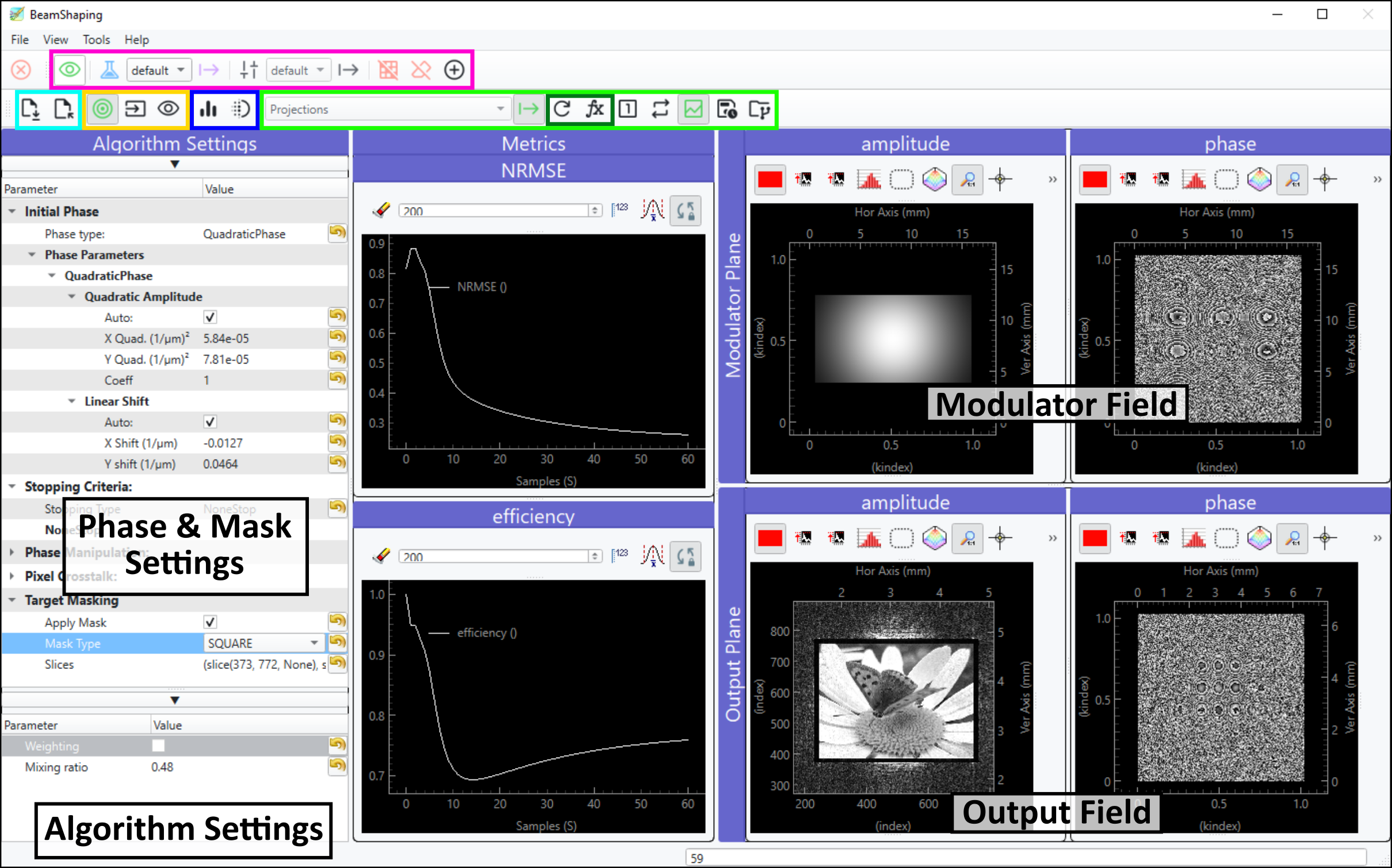
Fig. 1 The main Interface of the PyMoDAQ BeamShaping Toolbox
Documentation